Summary
Location, when it was built, who built it, why was it built
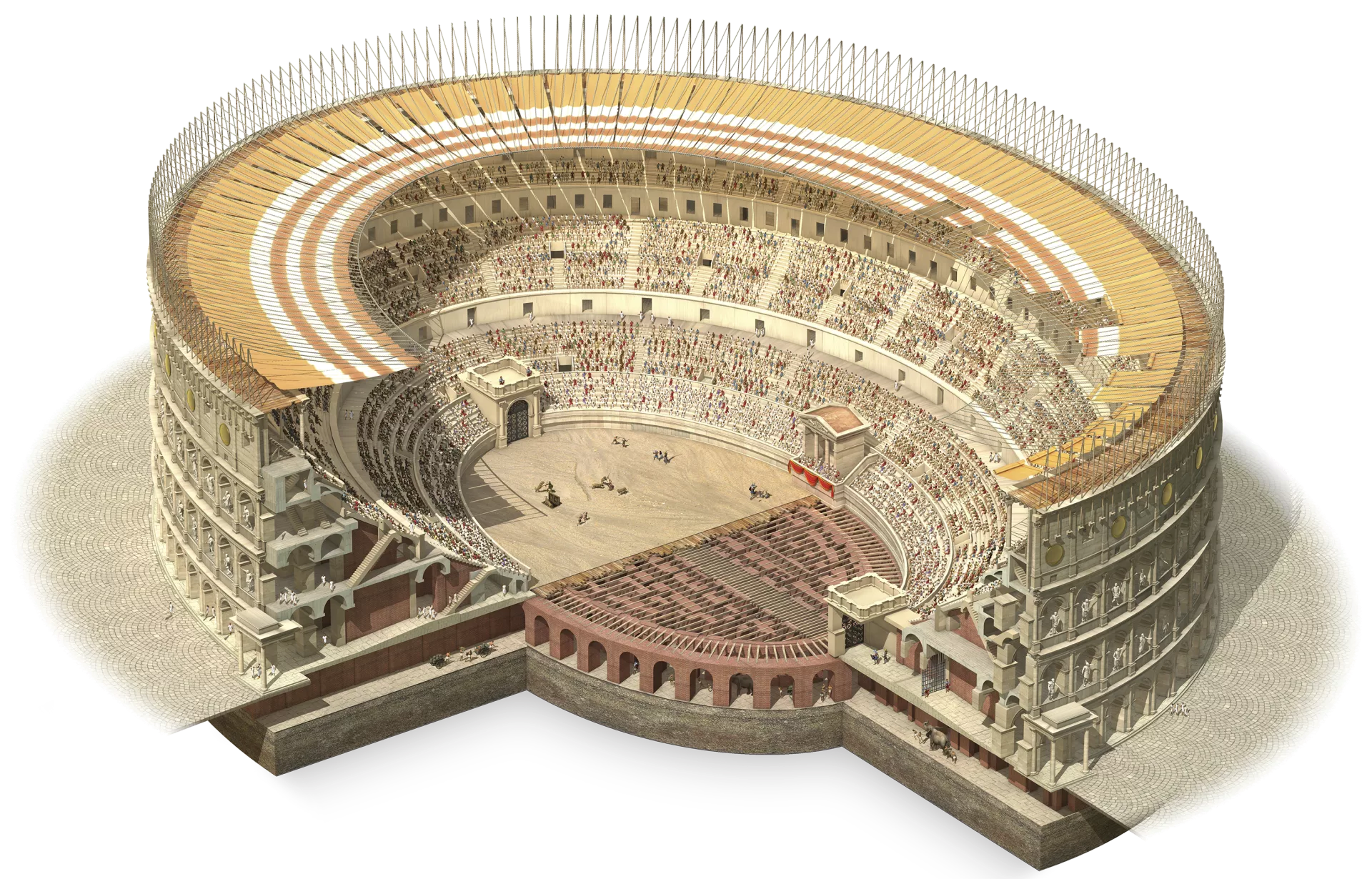
The Colosseum is in Rome, the capital of Italy. It is on the east bank of the Tiber river, east of the ancient Roman forum. At the time the Colosseum was built, the forum was a central location in the city. In this area were the main buildings of power, and a large square on which the population gathered.
The Colosseum started construction in 70 AD and was commissioned by the emperor (or Caesar) of that time, Vespasian.
Prior to the Colosseum, Rome had been governed by many emperors, but these emperors were quickly overthrown by other powerful people who in turn became emperors.
Rome was in turmoil when Vespasian came to power, and in order for his reign to be secure and risk-free, he wanted something to make him popular with the Roman people.
He decided to build the Colosseum. A huge ampithetre right in the centre of Rome, replacing an ornamental lake which was commissioned by one of the most disliked emperors of Rome, Nero.
Although he did not live to see the Colosseum completed, his son Titus completed the Colosseum in 80 AD. At this time it was called “the Flavian Amphitheatre” and was used as a political tool for other emperors.
They would host large gladiatorial games at no cost to the people, which would gain them popularity and make their rule more secure.
Drainage system
One of the most revolutionary things about the Colosseum is where it was built. When it was first planned to be built by the emperor Vespasian,
the only suitable place inside Rome was an ornamental lake. For the Colosseum to be built, however, the lake had to be drained of water first.
This was a massive task, as there were no power tools invented at that time.
Vespasian chose to build a massive trench around the lake, pave it with stone and cement and then drain it out into the Tiber river.
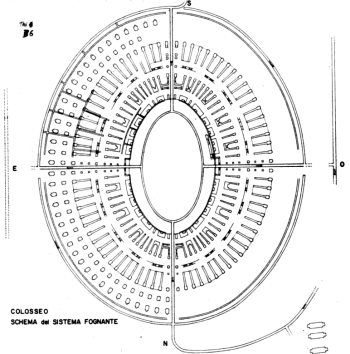
This was not only going to be for the lake, Vespasian also planned for the large channel to be used as a drainage system for the Colosseum to avoid flooding.
Roman engineers had to make the drains for the Colosseum on a gradient of two and a half per cent. Any less would leave the water stationary,
but any more and the water would back upon itself. To do this, the Romans found a perfect horizontal level, in which the engineers simply had to measure
down to get the drain’s gradient correct. This shows the engineer’s ingenuity in building the colosseum, further contributing to the fact that the Colosseum is a triumph.
There is also evidence of water fountains and toilet facilities within the Colosseum complex. The figure above shows the drainage network that was built into the design.
Shade System
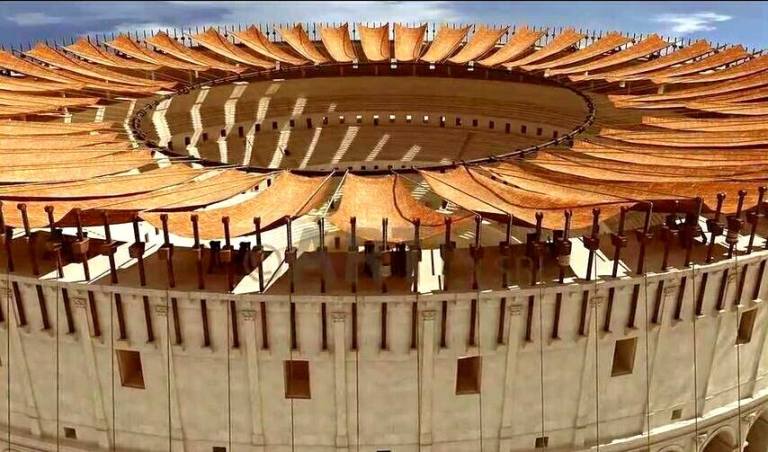
Historians estimate that the Colosseum could hold anything from 50 to 75 thousand spectators. These spectators were shaded by a retractable velarium (awning). This was made of shade cloth and wood.
It is estimated that the velarium would have covered about 30% of the inside of the Colosseum. The weight was estimated at around 24 tonnes. Historians believe 240 pillars made up the supports.
It was so large that to operate the awnings, the Romans had to employ hundreds of sailors to manipulate the ropes for the awning to work.
Hypogeum
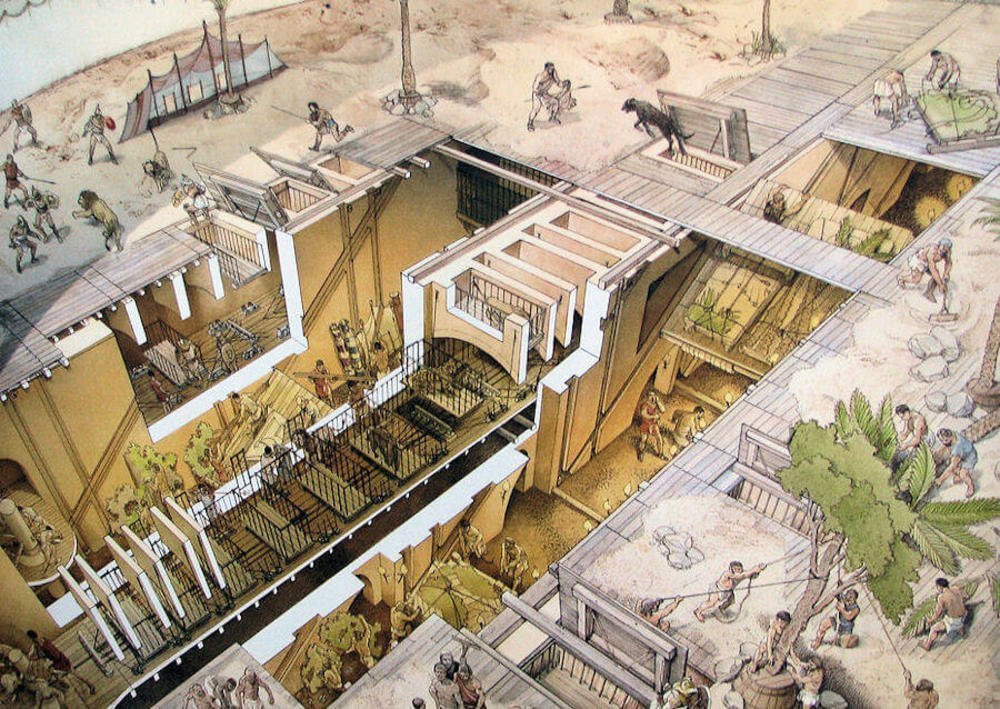
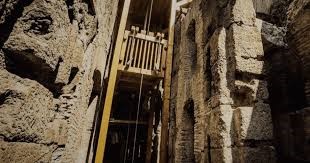
Underneath the Colosseum is the Hypogeum, a massive hollow area underground where the people worked underneath the arena floor “behind the scenes”.
These people were used to move wild animals, no bigger than a lion, up directly onto the arena floor via an array of pulleys. They would then be able to walk out
easily and entertain the masses through the slaughter of prisoners or being victims to animal hunters that were popular inside the Colosseum.
The hypogeum showed the intricacy of the design of the Colosseum. It was specifically designed to provide the people of Rome with entertainment, and the background technology was designed to compliment this.
Size and technology
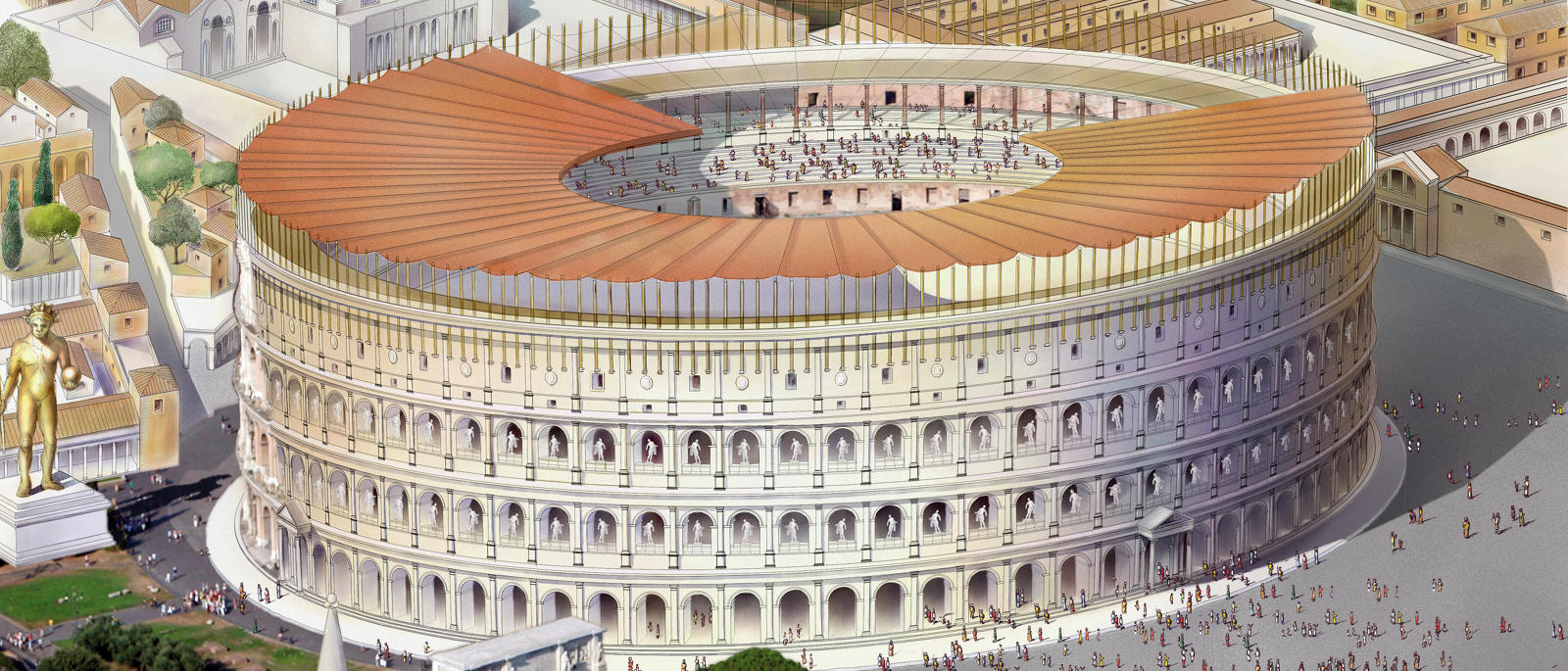
The Colosseum is impressive in it’s size even now. It is 48 metres tall, equivalent to a 14 storey building with an area 189 x 156 metres. It could
accommodate more than 50,000 viewers, with a total of 80 entrances.
The Colosseum is made from several materials including limestone, marble, tuff, volcanic rock, brick, and lime, bronze.
The Colosseum demonstrates some significant technology advancements by the Romans. The Colosseum is freestanding due to a complex system of arches. It would not have been possible without the invention of
concrete and vaulted arches. Concrete was used extensively in the construction of the arches and ceiling for the passages.
The outer façade was build of 100,000 cubic metres of Travertine limestone held together by 300 tonnes of iron clamps.
These facts, particularly the advancements in technology such as concrete and arches, plus the sheer size of the building contribute to the Colosseum being a triumph of its age.
Architecture
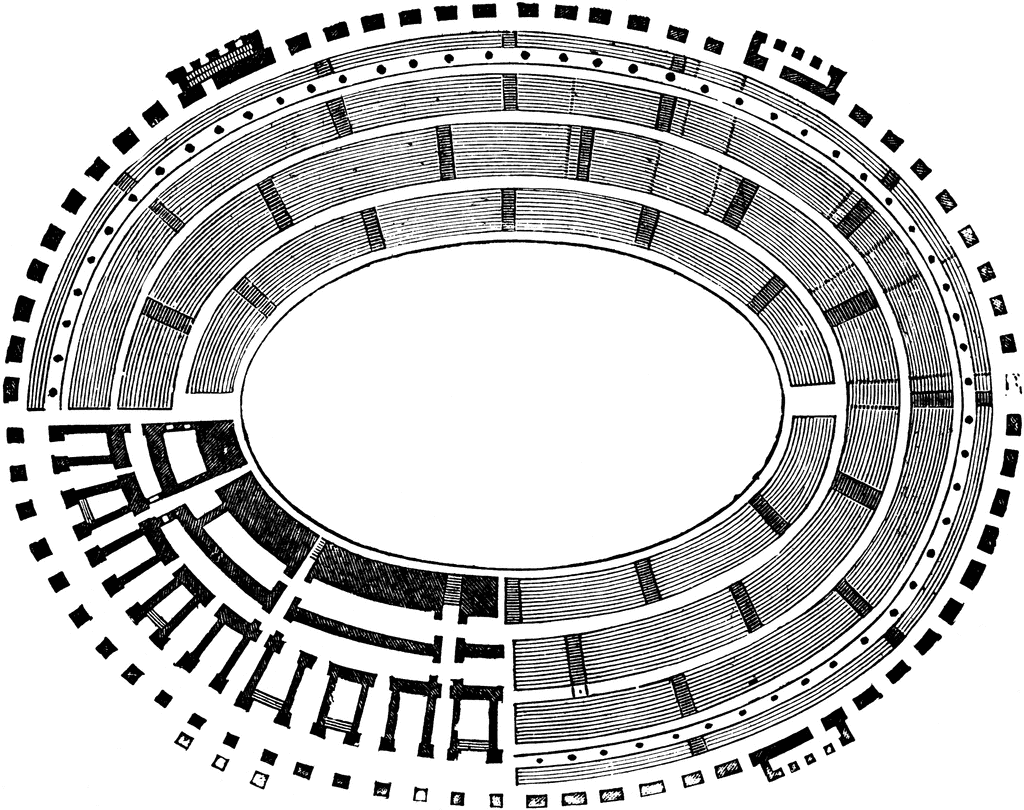
From the architect’s point of view, the Colosseum was a triumph. It is the larges ancient amphitheatre ever built. The Romans had limited tools, and the largest things that they built were houses that stood 3m above ground at the most. However, the outer wall of the Colosseum stood at 48m tall, with a shading mechanism which would have been extremely impressive for its time and an impressive drainage system.
The outer wall is estimated to have needed over 100,000 cubic metres of stone held together by iron clamps.
However, the Colosseum wasn’t just impressive because of its size on the outside, there was an underground area. This was where they stored the exotic animals and criminals, and to appear on the colosseum’s sandy floor, they were raised up through a special lift which worked with help from many pullies. This shows that from the Architect’s point of view the Colosseum is a triumph.
The Colosseum showed high levels of architectural design. The architects are unknown, lost in history, however their legacy in a building where drainage and the end purpose of the building is thought of in every aspect
leaves a triumphant legacy to this day.
Bibliography
Colosseum: Rome’s Arena of Death (YouTube video)
https://www.britannica.com/topic/colosseum
https://interestingengineering.com/the-colosseum-an-engineering-marvel-of-the-roman-empire
https://www.nationalgeographic.org/encyclopedia/colosseum/
https://www.rome.net/colosseum
https://www.smithsonianmag.com/history/secrets-of-the-colosseum-75827047/
http://www.stayciao.com/blog/a-quick-guide-to-the-roman-colosseum-architecture/
https://www.the-colosseum.net/architecture/cloacae_en.htm
https://theculturetrip.com/europe/italy/articles/a-history-of-the-colosseum-in-one-minute/
https://visit-colosseum-rome.com/colosseum-height/
https://visit-colosseum-rome.com/velarium/
https://www.walksinsiderome.com/blog/colosseum-underground-tour-the-ampitheatres-hidden-hypogeum/
https://www.wonders-of-the-world.net/colosseum/location-of-the-colosseum.php
Life in Rome in Ancient times by Paul Werner (1978)
Reader’s Digest Journeys Into The Past: Life in Ancient Rome Published by The Reader’s Digest Association Limited (1996)
Rome of the Caesars by Leonardo B.Dal Maso (1989)